.svg)
.svg)

Articles
All

Most tennis stats get written down once and never looked at again. The score tells you who won the point. It never tells you why.
Five numbers do the real diagnostic work: your first-serve percentage together with placement and speed; your unforced errors broken out by wing and by rally length; your win rate at different rally lengths; your return depth; and your net clearance. Between them they show where points are genuinely being won and lost, which is rarely where you think.
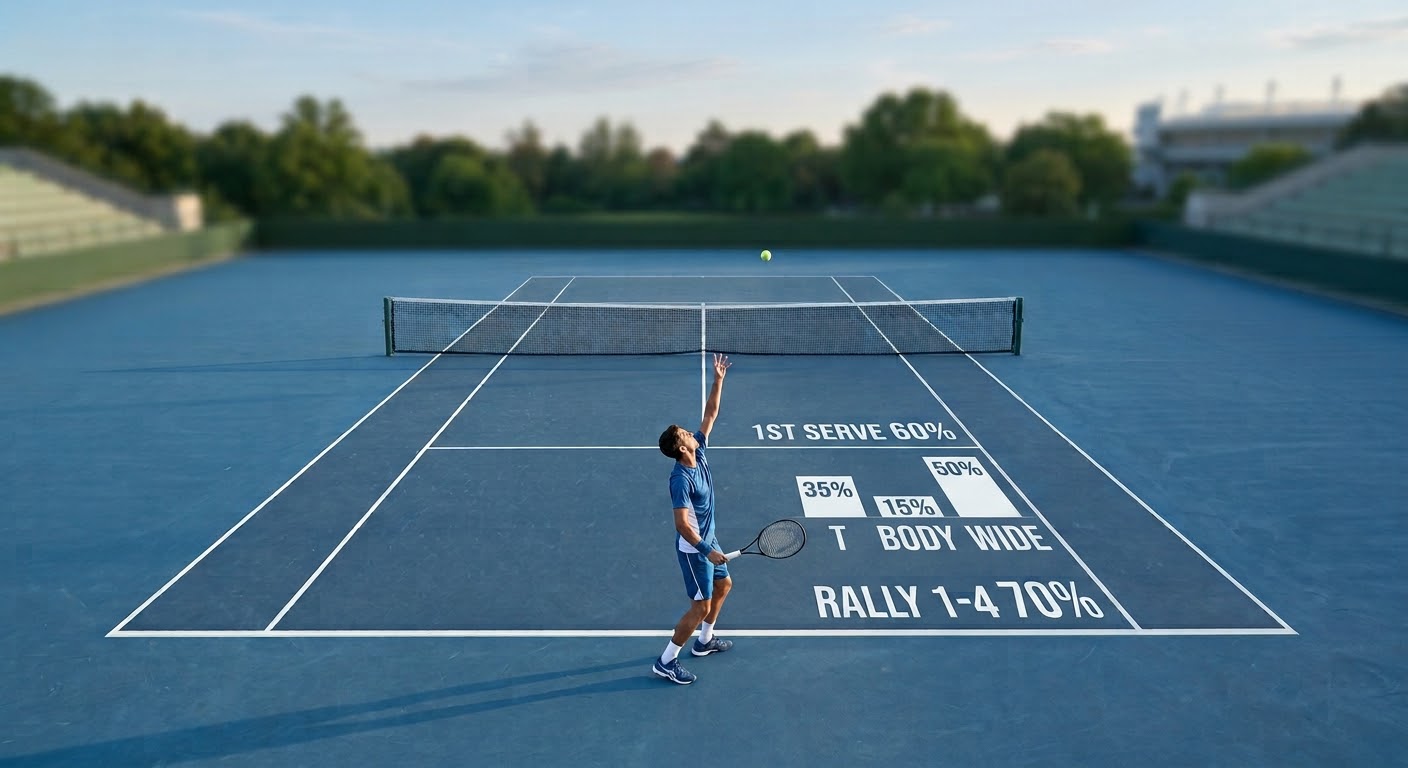
Craig O'Shannessy, who built a coaching career on rally-length data, puts the headline figure at roughly 70% of points ending within the first four shots — he walks through the reasoning in this conversation. And this isn't only a professional pattern. His First 4 Shots research draws on thousands of matches, from Australian Open data through college tennis to juniors of all ages, including more than 400,000 points of high school tennis and over 140,000 points at college level.
Serve, return, and the two balls after them decide most of a match. Most practice hours still go into long baseline exchanges. That gap is the entire argument for tracking anything at all.
Two players lose the same 6-3 set for opposite reasons. One coughs up twelve unforced backhand errors inside four shots. The other gets outplayed on serve and return and barely reaches a rally at all. Same scoreline on the sheet, two completely different practice weeks ahead.
This is why "work on the backhand" fails as a plan. It isn't wrong, it's just not something you can act on. "My backhand error rate doubles once the rally passes five shots" is something you can drill on Tuesday, measure on Thursday, and check again next month.
First-serve percentage is the most recorded number in tennis and the most misread. A 70% first-serve rate on its own tells you almost nothing. Knowing that 60% of those serves went to the T on the deuce side tells you a great deal.
Direction without speed is still half a picture. A serve to the T at 90mph gives the returner time to step in and set up. The same target 20mph quicker is a different shot. Placement and pace only become a weapon together.
Log direction — T, body, wide — on each side, and note your average speed by zone. If your T serve runs consistently slower than your wide serve, you're probably aiming rather than hitting: tightening up on the target and losing pace in the process. Easy to fix, almost impossible to spot without the numbers.
You already know which wing leaks more errors. What you almost certainly don't know is when they arrive, and that's the part that changes what you practise.
An unforced error in a four-shot point is a different animal from the same error at shot eight. The first usually points to technique, or a bad tactical choice with barely any pressure on. The second is more likely fitness, concentration, or decision-making after sustained pressure. Treat them as one problem and you'll practise the wrong thing.
Record errors by shot type and rally length. The pattern usually surfaces within two or three matches.
Split your matches into three brackets: 0–4 shots, 5–8 shots, 9 or more. Which bracket are you winning? Which one is quietly draining your matches?
Most competitive club players do one or the other. They dominate the short points and fade in long ones, or the reverse. Either answer is useful. Losing the 0–4 bracket means your serve, your return, or the first ball after them needs work — you're conceding points before the rally even starts. Losing the 9-plus bracket points to fitness, court position, or defense, and no amount of serve practice will touch it.
For focusing a training block, this one earns its keep faster than anything else on the list. It's also the stat almost nobody has, because counting shots and tracking who won the point at the same time is more than most people can manage while playing.
The return is the second most important shot in tennis and the least practiced. What matters most about it is simply where it lands.
Returns that drop inside the service box hand the server a free attacking ball. Returns landing at or behind the baseline reset the point on level terms.
Track the share of your returns landing in the deep third of the court. Under 50%, and you're giving away short balls before the rally has really begun.
Net clearance is the vertical gap between the ball and the tape as it crosses. It sounds like a technical footnote, and it's one of the most revealing numbers you can have.
Cut it too fine and the errors arrive the moment pressure rises. Clear by a meter and a half and you're feeding balls into your opponent's strike zone. The right margin depends on the shot: a first serve can skim the tape, a topspin forehand needs far more, a slice backhand plays by different rules again.
What net clearance really exposes is what pressure does to your technique. When clearance on a given shot drops off in longer rallies, fatigue or tension is pulling your contact point down, and the errors are about to follow. Track average clearance by shot type and watch what happens past the seventh ball.
Stats only count if they change what happens on court. Each of the five findings below points to one session you can run this week.
Low first-serve rate with no placement pattern — serve placement blocks. 20 serves to each target zone per side: T, body, wide. Score direction and speed, not just in or out. Aim for 60% first serves with at least half landing in a deliberate zone, and no speed drop on the target you find hardest. This is the one piece of the list you can do entirely alone, which is why it's also the easiest habit to build. (If you train with Baseline, this is Serve Strike, more or less exactly).
Errors clustered in short rallies — three-shot patterns. Serve, return, one more ball, stop. No extended rallies. It forces both players to execute the three shots that decide most points, over and over, under something close to match pressure.
Losing the 0–4 bracket — first-ball attack. After a deep return, the server attacks on shot three every single time, with no resetting to neutral. Count winners against errors on that third ball. The point is building the habit of finishing short points instead of drifting back into long ones.
Return depth under 50% — deep return blocks. The returner aims inside one metre of the baseline, and someone logs where the ball actually lands. 20 returns before any free play.
Net clearance dropping in long rallies — contact point work. 20 forehands or backhands to a target, with clearance and contact height tracked. The goal here is diagnosis: is the drop coming from fatigue, from a late takeback, or from tension at contact? Each one sends you somewhere different.
Here's the practical problem with everything above, and it isn't the one people expect.
You don't need a coach to run these drills. You need a hitting partner, and you almost certainly have one. What you don't have is a third person: someone standing at the side of the court logging where the ball landed and how much it cleared the net, while the two of you are busy playing.
That's the whole bottleneck. First-serve percentage and rough rally length are the only two things a person can reliably record live, which is exactly why they're the only two anyone ever tracks. Net clearance, return depth, and errors broken down by wing and rally length need either a dedicated spectator at every session or a video review afterwards — and even then the data comes out patchy.
Work through the list with pen and paper and you can feel exactly where it collapses. First serve is fine — one mark per serve for in or out, plus the zone. Rally length is possible, but only for someone watching rather than playing, because you're counting shots and recording who won the point at the same time. Unforced errors need two marks each, the wing and the bracket, and they're the first thing you lose track of once a set gets tight. Return depth is genuinely hard to judge from inside the court. And net clearance in metres over the tape is not something a person can estimate at all.
Automatic shot tracking removes the person from the equation. Baseline Training records serve speed and placement (wide, body, T), shot speed, ball placement including returns, net clearance, in/out percentage, rally length and stroke counts while you play, alongside instant replay with zoom and frame-by-frame review. Four of the five stats above come out of a normal session without anyone writing anything down. The fifth — errors sorted by wing — you read off the placement map afterwards rather than getting as a number.
The tooling matters less than the habit, though. If you're not measuring it, you're guessing, and improvement built on guesswork takes far longer than it needs to.
What is a good first-serve percentage in tennis? For competitive club players, 55–65% is a fair target. Below 50% means most of your points start from the weaker second-serve position. But the percentage alone is incomplete: direction and pace matter just as much. A 65% first-serve rate with no placement pattern and no pace is worth less than 58% where most serves hit a chosen zone at a consistent speed.
How do coaches use statistics to improve player performance? The approach that works is tracking a small number of metrics consistently across several sessions and looking for the pattern. A coach who knows a player's backhand error rate spikes in 5–8 shot rallies can design practice for exactly that pressure zone. Stats turn a vague sense of what's wrong into a training agenda.
Can recreational players benefit from tracking tennis statistics? Yes, and often more than professionals do, because the patterns are larger and easier to act on. A club player losing 75% of short-point exchanges has one obvious priority, and the diagnosis takes a single session.
How many stats should you track at once? One to three. Tracking everything produces noise and no decisions. Pick the metric closest to where you're losing points, follow it for four to six sessions, act on it, then reassess. Most players start with first-serve percentage and unforced error rate, since both are easy to capture and tie directly to results.
What is rally length in tennis and why does it matter? Rally length is the number of shots in a point, counting the serve. Craig O'Shannessy's research puts around 70% of points inside the first four shots. Knowing which rally lengths you win and lose tells you whether your serve, return and first-ball patterns are doing their job, or whether you're winning the long exchanges and still losing matches.
What is net clearance in tennis? Net clearance is the vertical distance between the ball and the top of the net as it passes over. Tracked by shot type, it shows whether you're taking on too much risk by skimming the tape, playing too safe and sitting the ball up in your opponent's strike zone, or losing your margin under pressure in long rallies.
If you want to track these metrics automatically in your sessions, Baseline Training captures serve speed, shot placement, net clearance, and rally stats in real time so coaches and players can review the patterns after every practice.